
Contents
Overview
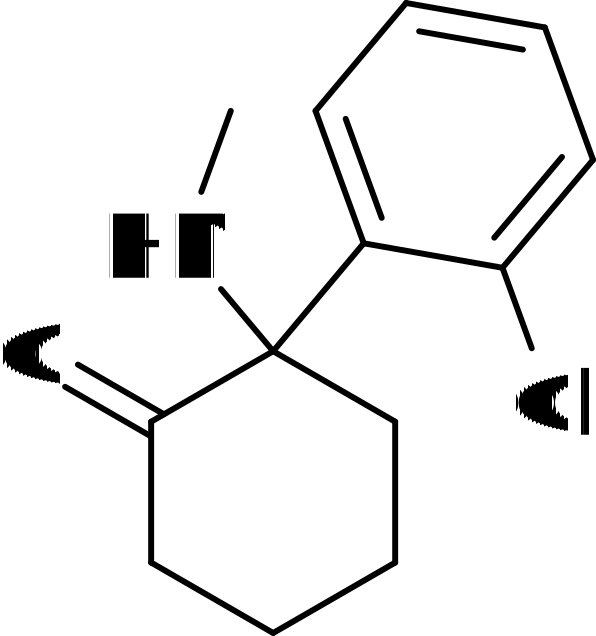
Ketamine, once primarily known as a dissociative anesthetic, is now recognized for its profound therapeutic potential, particularly in treating severe depression and other mental health conditions. Its unique mechanism of action, primarily as an NMDA receptor antagonist, allows for rapid antidepressant effects that differ significantly from traditional psychiatric medications. While its anesthetic properties were established in the 1960s, the exploration of its sub-anesthetic doses for mood disorders gained significant traction in the early 21st century, leading to the development of treatments like esketamine nasal spray. This shift has opened new avenues for individuals suffering from treatment-resistant depression, chronic pain, and PTSD, offering hope where other therapies have failed. However, its use is not without controversy, involving careful medical supervision due to potential side effects and risks of misuse.
🎵 Origins & History
The journey of ketamine began in the early 1960s at Parke, Davis & Company (now part of Pfizer). Ketamine was synthesized as a safer alternative to PCP, another dissociative anesthetic with significant side effects. Initial trials in the early 1960s, particularly by Max L. Wallace, demonstrated its efficacy as a dissociative anesthetic with a more favorable safety profile. Approved by the U.S. Food and Drug Administration in 1970, ketamine quickly became a vital tool in emergency medicine and surgery due to its rapid onset and ability to preserve respiratory drive, a stark contrast to many other anesthetics of the era. Its widespread adoption in clinical settings, from battlefield medicine during the Vietnam War to pediatric care, cemented its status as an essential anesthetic agent.
⚙️ How It Works
Ketamine's therapeutic magic lies in its unique interaction with the brain's neurochemistry, primarily through its role as an NMDA receptor antagonist. Unlike traditional antidepressants that target monoamine systems like serotonin and norepinephrine, ketamine's rapid antidepressant effects are thought to stem from its ability to quickly increase synaptic levels of glutamate, the brain's primary excitatory neurotransmitter. This surge in glutamate activity then triggers downstream signaling pathways, including the activation of BRAF and mTOR, which promote the growth of new synaptic connections, a process known as synaptogenesis. This neuroplastic effect is believed to be crucial in reversing the neuronal atrophy associated with chronic stress and depression, offering a swift and powerful intervention for mood disorders. The specific enantiomer, esketamine, has been further refined for its antidepressant properties.
📊 Key Facts & Numbers
Globally, over 50 million major depressive disorder patients exist, with approximately one-third experiencing treatment-resistant depression (TRD). Clinical trials have shown that ketamine infusions can achieve remission rates of up to 70% in TRD patients within days, a remarkable figure compared to the 30-40% response rate of traditional antidepressants over several weeks. The global market for ketamine, encompassing anesthetic and therapeutic uses, is projected to reach over $2.5 billion by 2027, indicating significant growth. Esketamine, marketed as Spravato by Janssen Pharmaceuticals, received FDA approval in 2019 for TRD and major depressive disorder with suicidal thoughts, with over 10,000 prescriptions filled in its first year. The cost of ketamine therapy can range from $400 to $1,500 per infusion session, with multiple sessions often required.
👥 Key People & Organizations
The scientific exploration of ketamine's therapeutic potential has been spearheaded by researchers like John Krystal and Maria Ascher, whose work at Yale University in the late 1990s and early 2000s illuminated its rapid antidepressant mechanisms. Carlos Zarate Jr. at the National Institute of Mental Health (NIMH) also played a pivotal role in demonstrating ketamine's swift mood-lifting effects in human trials. Organizations such as the Ketamine Advocacy Network and patient advocacy groups have been instrumental in raising awareness and pushing for broader access to ketamine therapy. Pharmaceutical companies like Allergan (now part of AbbVie) with its esketamine nasal spray, Compass Pathways developing psilocybin-assisted therapy, and numerous ketamine clinics worldwide are key players in the evolving landscape of psychedelic-assisted mental healthcare.
🌍 Cultural Impact & Influence
Ketamine's cultural resonance extends beyond clinical settings, permeating discussions on mental health and consciousness. Its dissociative properties have made it a subject of interest in subcultures and artistic expression, sometimes associated with rave culture and underground music scenes. The rapid, almost mystical, shifts in perception it can induce have been explored in literature and film, though often sensationalized. The growing acceptance of ketamine as a legitimate medical treatment has begun to destigmatize the broader conversation around psychedelic substances, paving the way for research into other compounds like psilocybin and MDMA. This cultural shift is influencing public perception and policy, moving from a purely prohibitionist stance to one that acknowledges therapeutic potential.
⚡ Current State & Latest Developments
As of 2024, ketamine therapy is experiencing a significant expansion, with an increasing number of clinics offering intravenous infusions and intranasal esketamine treatments. The development of novel formulations and delivery methods, including oral and intramuscular options, is ongoing to improve patient convenience and accessibility. Regulatory bodies worldwide are continuously evaluating the evidence for ketamine and related compounds, leading to evolving guidelines for their use. Research is also expanding into new therapeutic applications, such as for PTSD, OCD, and substance use disorders. The integration of ketamine therapy into mainstream mental healthcare systems remains a key focus, alongside efforts to ensure equitable access and affordability.
🤔 Controversies & Debates
The rapid antidepressant effects of ketamine, while revolutionary, are not without their challenges and debates. Concerns persist regarding the long-term safety of repeated ketamine use, particularly potential bladder toxicity (ketamine cystitis) and cognitive impairments, though these are more commonly associated with chronic recreational abuse than supervised therapeutic use. The mechanism of action, while increasingly understood, still holds mysteries, with ongoing debate about the precise pathways responsible for its antidepressant effects and the role of metabolites. Furthermore, the high cost of ketamine therapy and issues of insurance coverage create significant access barriers for many patients, sparking debates about healthcare equity and the classification of ketamine as a 'lifestyle drug' versus essential medicine. The potential for misuse and diversion also remains a significant concern for regulatory agencies and law enforcement.
🔮 Future Outlook & Predictions
The future of ketamine therapy appears bright, with ongoing research aiming to refine its application and expand its reach. Scientists are investigating personalized dosing strategies and combination therapies to optimize outcomes and minimize side effects. The development of non-addictive, non-hallucinogenic ketamine derivatives is a major area of focus, potentially offering the therapeutic benefits without the associated risks. Furthermore, the success of ketamine has paved the way for rigorous investigation into other psychedelic and dissociative compounds, such as psilocybin and MDMA, for a wider range of mental health conditions. As research progresses, we may see ketamine and its analogues become standard treatments for a spectrum of psychiatric and neurological disorders, integrated seamlessly into mental healthcare protocols by the end of the decade.
💡 Practical Applications
Ketamine's primary practical application is in anesthesia, where it's used for induction and maintenance, particularly in emergency settings and for pediatric patients due to its safety profile and preserved airway reflexes. Beyond anesthesia, its most significant therapeutic use is in treating treatment-resistant depression (TRD), where it is administered via intravenous infusion or intranasal spray (esketamine). It's also increasingly used for chronic pain management, including neuropathic pain and fibromyalgia, often at sub-anesthetic doses. Emerging applications include treatments for PTSD, OCD, and suicidal ideation, with ongoing clinical trials exploring its efficacy in these areas. The establishment of specialized [[ketamin
Key Facts
- Category
- therapeutic-uses
- Type
- topic